Preventing Contamination in Wine and Beer Kegs: Common Mistakes and How to Avoid Them
How to reduce production times and operating costs through beverage packaging automation
How to reduce production times and operating costs through beverage packaging automation
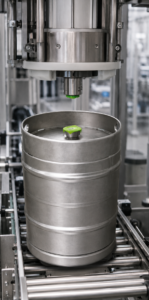
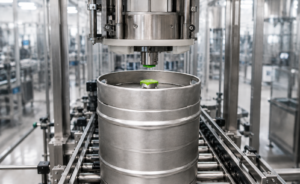
In the beverage industry, competitiveness no longer depends solely on product quality. The ability to optimise production processes, reduce waste and improve logistics management is becoming increasingly important. In this context, automatic keg sealing is an increasingly strategic solution for companies managing high production volumes and large-scale distribution.
The packaging stage is, in fact, one of the most critical points of the production line, where repetitive tasks, waiting times and often underestimated operating costs tend to accumulate. Automating keg sealing and packaging makes it possible to address these issues directly, improving production continuity and reducing inefficiencies.
Companies investing in packaging automation are not simply seeking greater speed. They are looking for better process control, increased operational safety and more efficient logistics management. Let us therefore examine how keg sealing automation can effectively reduce production times, optimise logistics and lower operating costs.
Sealing automation: a critical point in the production line
Keg handling is a fundamental stage in beverage production, whether products are packaged in kegs, cans or bottles, and represents a crucial point in maintaining production line continuity. Every manual or semi-manual operation inevitably introduces delays, variability and the risk of human error, with direct consequences for overall productivity.
Introducing automation into the keg sealing process helps eliminate one of the most common bottlenecks in the beverage supply chain. An automatic system ensures consistent, uniform and repeatable sealing, improving process quality while reducing operational interruptions.
From an industrial perspective, production process automation makes it possible to standardise operations and reduce low-value-added activities. Operators can therefore focus on monitoring and supervision tasks, increasing both workplace safety and operational efficiency.
The most significant benefits include:
- greater production continuity;
- fewer human errors;
- improved workplace safety;
- increased production capacity without increasing staffing levels.
The transition towards industrial automation systems is therefore a natural step for companies seeking to grow sustainably while remaining competitive.
Logistics optimisation and reduced operating costs
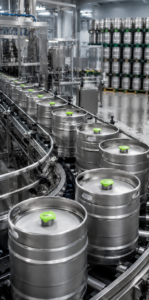
One of the most immediate benefits of automatic keg sealing concerns both internal and external logistics. Efficient keg management helps reduce handling times, improve traceability and lower warehouse management costs.
When sealing is automated, kegs can be integrated smoothly into the logistics optimisation of the entire production facility. The speed and precision of the process help reduce production line downtime and improve shipment planning.
This leads to a tangible reduction in operating costs through:
- shorter processing times;
- reduced waste and rework;
- improved warehouse flow management;
- greater delivery reliability.
Logistics efficiency therefore becomes a genuine competitive advantage. A faster and more predictable production flow enables companies to respond more quickly to market demand and improve their reliability in the eyes of customers and distributors.
Over the long term, the combination of process optimisation and automation can significantly reduce the total cost of production, improving company margins.
Logistics optimisation and reduced operating costs
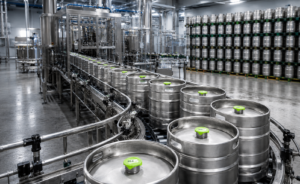
One of the most immediate benefits of automatic keg sealing concerns both internal and external logistics. Efficient keg management helps reduce handling times, improve traceability and lower warehouse management costs.
When sealing is automated, kegs can be integrated smoothly into the logistics optimisation of the entire production facility. The speed and precision of the process help reduce production line downtime and improve shipment planning.
This leads to a tangible reduction in operating costs through:
- shorter processing times;
- reduced waste and rework;
- improved warehouse flow management;
- greater delivery reliability.
Logistics efficiency therefore becomes a genuine competitive advantage. A faster and more predictable production flow enables companies to respond more quickly to market demand and improve their reliability in the eyes of customers and distributors.
Over the long term, the combination of process optimisation and automation can significantly reduce the total cost of production, improving company margins.
Sustainable packaging and reduced environmental impact
Today, choosing sustainable packaging is no longer simply an option, but a strategic necessity. Beverage companies are increasingly expected to reduce their use of plastic and integrate recyclable materials into their production processes.
Reducing plastic in keg packaging represents a tangible step towards more sustainable industrial models. Adopting solutions based on circular economy principles helps reduce waste while improving brand perception among both the market and commercial partners.
Integrating recyclable materials means:
- reducing the environmental impact of packaging;
- preparing for increasingly stringent environmental regulations;
- strengthening corporate reputation;
- responding to consumer expectations.
Sustainability therefore becomes a driver of innovation, capable of positively influencing the entire value chain and strengthening a company’s long-term competitiveness.
Sustainable packaging and reduced environmental impact
Today, choosing sustainable packaging is no longer simply an option, but a strategic necessity. Beverage companies are increasingly expected to reduce their use of plastic and integrate recyclable materials into their production processes.
Reducing plastic in keg packaging represents a tangible step towards more sustainable industrial models. Adopting solutions based on circular economy principles helps reduce waste while improving brand perception among both the market and commercial partners.
Integrating recyclable materials means:
- reducing the environmental impact of packaging;
- preparing for increasingly stringent environmental regulations;
- strengthening corporate reputation;
- responding to consumer expectations.
Sustainability therefore becomes a driver of innovation, capable of positively influencing the entire value chain and strengthening a company’s long-term competitiveness.
Innovation and competitiveness with KEGSYL
Keg sealing automation is now a strategic choice for beverage companies seeking to increase operational efficiency, improve keg logistics and reduce costs throughout the production chain.
Investing in innovative systems means accelerating the digital transformation of the production facility, improving productivity and adopting increasingly important sustainable packaging models in response to market expectations.
Solutions such as KEGSYL demonstrate how technological innovation can make a tangible contribution to process optimisation, supporting beverage companies as they move towards more efficient, sustainable and competitive production.